.png)
What is a Montessori school?
We often hear young children say "I want to do it myself". Well, a Montessori classroom is designed for exactly that.
Dr. Maria Montessori used observation, study and experimentation to understand how children learn. Modern studies have validated her work, showing many benefits for the whole development of children.
Opened in 1906, "Casa dei Bambini" or "the Children's House", in San Lorenzo, Italy was Montessori's first school with neurotypical children. (Her first work in education was among children with developmental delays).
Today, Montessori is the largest pedagogy in the world.
Casa's lead guide received her AMI diploma in 2016, through the Southwest Institute of Montessori Studies. We invest in our teachers to recieve this high level of training.
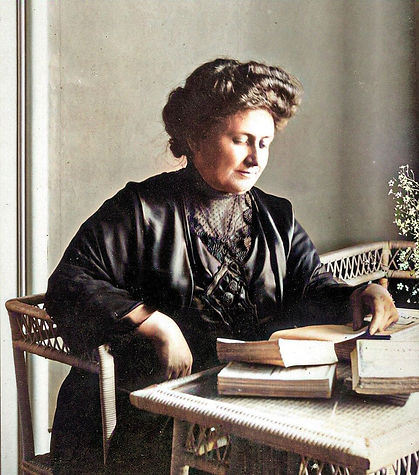
Who was Montessori?
Dr. Maria Montessori was among the first female physicians to come out of Italy - and the first to do it at the University of Rome.
She did not set out to revolutionize education, but that is exactly what she did. Just about everything we do right in education today was built on her work.
She used scientific methods to discover the way children learn. She tested her theories over decades and all around the world, and shed light on universal principles in her writing and trainings.
Montessori education meets the needs of childhood development. It has been shown to even the socioeconomic playing field in terms of education for young children. Her first work in education was with children with special needs.
She was a prolific writer, trained thousands of teachers and taught many thousands of children.
Her work is still relevant today, and with academic decline, behavioral & executive functioning problems growing rapidly among our youth, we believe it is needed now more than ever.
What to look for
in a Montessori school
The name Montessori is not trademarked, and therefore anyone can call their school a Montessori school.
Association Montessori Internationale (AMI) was the first organization to train teachers in Montessori's methods. Begun by Dr. Montessori and her son in 1929, AMI is dedicated to the highest level of quality and authenticity.
Casa's owner & lead guide received her AMI diploma in 2016, through the Southwest Institute of Montessori Studies. We invest in our teachers to recieve this high level of training.
Here are some things to look for when you are touring schools:
-
Are the teachers trained and certified, and if so, by whom?
-
Does the school affiliate with AMI, AMS or other reputable Montessori organizations?
-
Are parents encouraged to observe a classroom during a full work cycle?
-
Are children given a free choice of work?
-
Is there an uninterrupted 2-3 hour "work cycle" in the mornings?
-
Are all areas of the Montessori classroom available to children during their work cycles?
-
What are the adults doing? (observing, giving one-on-one, or small group lessons?)
-
Is there a calm, focused atmosphere in the classroom (with movement and chatter among the children)
-
Is there an outdoor environment always available to children?
The Montessori Approach
A Montessori classroom includes the child, the Prepared Environment, and a trained, caring adult.

The Child
Learning to walk and talk take a lot of effort, and yet children don't need to be convinced that they need to learn to do it. They just do it! Young children are driven by sensitive periods, and they instinctively know what they need to learn next.
By using their hands, imitation and repetition, children gain the skills they need to master their current developmental stage, and get ready for what's next.

The Prepared Environment
A Montessori classroom is also referred to as "The Prepared Environment". Each activity - called "work" is designed to help them develop needed skills. Trusting that they are driven by their internal wisdom, children have a free choice of work, within appropriate limits.
Time outdoors (dressed for the weather) is always part of the day.

The Adult
The adult is an essential part of a Montessori classroom. Having an in-depth knowledge of child development, the adult, or "guide" creates the prepared environment. She also observes the child to see what she is ready for next. The guide models how to use the material and maintains order in the classroom with gentle reminders and demonstrations when needed.
The Montessori classroom is made up of 4 different areas: Practical Life, Sensorial, Language & Culture, and Mathematics
The Montessori Classroom
Practical Life
Young children are eager to care for themselves and to do meaningful work.
In Montessori, they are shown how to do things like fasten buttons, wash dishes, water plants and the like. As a result, their confidence and sense of responsibility flourishes.
We are always taking information in with our senses. The sensorial materials help children make sense of this information.
Many of these materials prepare the child for mathematics and writing skills.

language
& culture
Young children are absorbing language from the beginning.
Montessori's methods bypass common obstacles to reading and writing that can occur with traditional methods.
As part of language study, materials are offered to help children learn about their local culture, cultures around the world, and geography.
Taking children from one to a thousand, through all of the operations, time and fractions, Montessori math is a hands-on, methodical & thorough approach to a concrete understanding of mathematical concepts. The child has extensive experience with concrete math concepts before moving to abstraction.


Sensorial
Exercises

mathematics
What the Literature says about Montessori
There have been thousands of studies on Montessori's work and adjacent issues. We've gathered a few to share.
Ages 0–6: The Most Critical Window of Brain Development
-
90% of brain development occurs before age 5
-
Neural pathways are formed through:
-
Movement
-
Sensory interaction
-
Repetition and concentration
-
-
Early environment directly shapes:
-
Attention span
-
Emotional regulation
-
Cognitive ability
-
Citation:
-
Center on the Developing Child, Harvard University
-
Shonkoff & Phillips (2000)
Early experience is not preparation for life—it is life-building
Mismatch Between Developmental Needs and Modern Environments
-
Increased screen exposure → passive learning
-
Overstimulating environments → fragmented attention
-
Adult-directed learning → reduced independence
Outcomes:
-
Reduced focus and self-regulation
-
Increased behavioral challenges
-
Lower intrinsic motivation
Supporting Research:
-
Christakis (2018) – screen time & attention
-
American Academy of Pediatrics (AAP)
Children are adapting to environments that do not support optimal development
Outcomes in Low-Income Settings
Study: Lillard et al. (2017 follow-up research)
Findings:
Montessori students:
-
Closed achievement gaps
-
Showed equal or better outcomes vs higher-income peers
Montessori is effective across socioeconomic backgrounds
Landmark Study: Montessori vs Traditional Preschool
Study: Lillard & Else-Quest (2006) Published in Science
Design:
-
Compared Montessori vs traditional preschool (ages 3–6)
-
Lottery-based admission (reduces selection bias)
Key Findings:
Cognitive & Academic
-
Higher reading and math scores
-
More advanced language development
Executive Function
-
Stronger working memory
-
Greater cognitive flexibility
-
Improved self-control
Social & Emotional
-
More prosocial behavior
-
Greater fairness and collaboration
-
Reduced aggression
Primary Study:
-
Lillard & Else-Quest (2006), Science
Montessori students outperform peers across academic, cognitive, and social domains
Early Montessori Education Drives Long-Term Outcomes
-
Better performance in math and science (high school level)
-
Stronger sense of community and social responsibility
Study:
-
Dohrmann et al. (2007)
Additional Insight:
-
Executive function predicts:
-
Academic success
-
Career outcomes
-
Life stability
-
Supporting Research:
-
Diamond & Lee (2011), Science
Early investment in executive function yields lifelong returns
Montessori Aligns with Developmental Science
Montessori environments are designed to:
-
Support sustained attention (uninterrupted work cycles)
-
Develop independence (child-led activity)
-
Integrate movement with cognition
-
Build intrinsic motivation
Research Synthesis:
-
Lillard (2017) – Montessori: The Science Behind the Genius
Montessori is not merely a philosophy—it is an evidence-aligned system
Research on Movement + Learning
Study: Ratey (2008) – “Spark” + supporting neuroscience
Findings:
-
Movement improves:
-
Attention
-
Memory
-
Emotional regulation
-
Montessori Alignment:
-
Children are not confined to desks
-
Movement is integrated into learning
still want to learn more
about montessori?
Angeline Lillard PhD, dives into what science and study are telling us about Montessori's method:
AUTHOR SITE | Montessori: Science Behind the Genius (Lillard) PNASMontessori Science
Learn more about Maria Montessori's life and work here:
Inside Montessori | Official Film Website
Some of Montessori's books in the public domain can be found here:
Purchase print copies of most of Montessori's books here:
Montessori Series English – Montessori Pierson Publishing Company
Association Montessori Internationale was created in 1929 by Maria Montessori's son, Mario. His goal was to preserve her methods and philosophies, and this organization continues to issue dimplomas even today. Check out their website here:
Association Montessori Internationale |
AMI's Youtube channel can be found here: